
IGCSE Physics Revision Notes Motion

Download PDF

IGCSE Physics  Notes Motion

Core + Supplement Objectives • Notes + Graph Questions + Reveal Answers
How to use this page: Learn the definitions first, then practise the graph questions. For calculations and longer answers, click Reveal Answer to see clear steps, method marks, and mark scheme style hints.

1Key Definitions and Formulae

Speed
Distance travelled per unit time.
Velocity
Speed in a given direction.
Average speed
Total distance travelled divided by total time taken.
Acceleration
Change in velocity per unit time.
Deceleration
Negative acceleration. The object is slowing down.
Free fall
Motion when gravity is the only force acting on the object.
Important Equations
speed = distance ÷ time
velocity = distance in a given direction ÷ time
average speed = total distance ÷ total time
acceleration = change in velocity ÷ time
Useful Rearrangements
distance = speed × time
time = distance ÷ speed
change in velocity = final velocity - initial velocity
Gravitational field near Earth: The acceleration of free fall, g, is approximately constant and is about 9.8 m/s2.

2How to Interpret Motion Graphs

Distance–Time Graph
Shape of graph Meaning
Horizontal line Object is at rest
Straight sloping line Object is moving at constant speed
Steeper straight line Greater speed
Curved line getting steeper Object is accelerating
Curved line becoming less steep Object is decelerating
Speed–Time Graph
Shape of graph Meaning
Horizontal line above time-axis Object moves with constant speed
Line rising straight up Constant acceleration
Curve Changing acceleration
Line sloping downward Deceleration / negative acceleration
Area under graph Gives the distance travelled
Gradient of graph Gives the acceleration

3Quick Exam-Style Practice

Question 1

Define speed, velocity and average speed. [3]

Reveal Answer
Speed: distance travelled per unit time.
Velocity: speed in a given direction.
Average speed: total distance travelled divided by total time taken.
Question 2

A car travels 360 m in 20 s. Calculate its speed. [2]

Reveal Answer
Step 1: Use the formula speed = distance ÷ time.
Step 2: Substitute the values:
speed = 360 ÷ 20
Step 3: speed = 18 m/s
Mark scheme style hint: 1 mark for correct formula/method, 1 mark for correct answer with unit.
Question 3

A runner completes a race of 1500 m in 300 s. Calculate the average speed. [2]

Reveal Answer
Step 1: average speed = total distance ÷ total time
Step 2: average speed = 1500 ÷ 300
Step 3: average speed = 5.0 m/s
Question 4

A cyclist changes velocity from 4 m/s to 10 m/s in 3 s. Calculate the acceleration. [3]

Reveal Answer
Step 1: acceleration = change in velocity ÷ time
Step 2: change in velocity = 10 ? 4 = 6 m/s
Step 3: acceleration = 6 ÷ 3 = 2 m/s2
Mark scheme style hint: Show the change in velocity clearly. That often earns the method mark.
Question 5

Explain what is meant by deceleration. [1]
Reveal Answer
Deceleration is negative acceleration, meaning the object is slowing down.

4Graph Question – Distance–Time Graph

Graph Question A

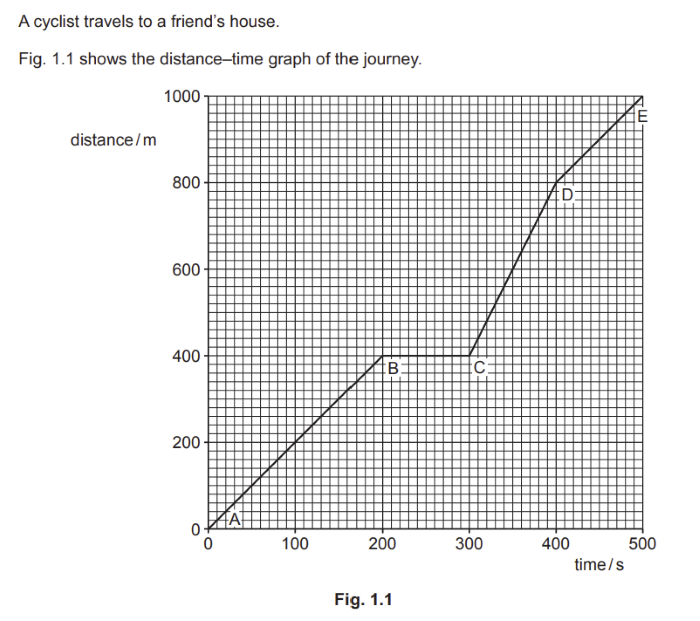
A cyclist travels to a friend’s house. The distance–time graph has points: A(0 s, 0 m), B(200 s, 400 m), C(300 s, 400 m), D(400 s, 800 m) and E(500 s, 1000 m).

(a) Determine the distance travelled by the cyclist between points C and E. [2]

Reveal Answer
Step 1: Read the distances from the graph.
At C, distance = 400 m
At E, distance = 1000 m
Step 2: Distance travelled between C and E = 1000 ? 400
Answer: 600 m
Mark scheme hint: A clear subtraction using the two graph readings usually earns full credit.

(b) Describe the motion of the cyclist between points B and C. [1]

Reveal Answer
Between B and C, the graph is horizontal, so the cyclist is at rest / stationary / not moving.

(c) State the section AB, BC, CD or DE in which the speed of the cyclist is the fastest. Give a reason. [2]

Reveal Answer
Section: CD
Reason: CD is the steepest section of the distance–time graph, so it has the greatest gradient, which means the greatest speed.
Mark scheme hint: “Steepest” or “largest gradient” is the key physics phrase here.

(d) Calculate the average speed of the cyclist between points A and E. Include the unit. [4]
Reveal Answer
Step 1: Use average speed = total distance ÷ total time
Step 2: From A to E, total distance = 1000 m
Step 3: From A to E, total time = 500 s
Step 4: average speed = 1000 ÷ 500
Answer: 2.0 m/s
Mark scheme hint: Examiners like to see the formula, substitution, answer, and unit.

5Graph Question – Speed–Time Graph

Graph Question B

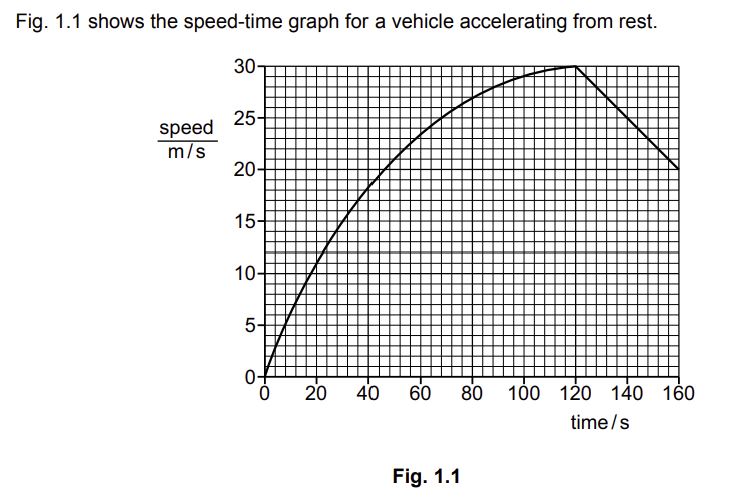
A vehicle accelerates from rest. The speed–time graph rises to 30 m/s at 120 s, then falls to 20 m/s at 160 s.

(a) Calculate the acceleration of the vehicle at time t = 30 s. [3]

Reveal Answer
Step 1: Acceleration is the gradient of a speed–time graph.
Step 2: Draw a tangent at t = 30 s and choose two points on the tangent.
Step 3: Calculate gradient using:
acceleration = change in speed ÷ change in time
Answer: The accepted answer is in the range 0.30 to 0.45 m/s2 depending on the tangent drawn neatly.
Mark scheme hint: Mentioning gradient or tangent is essential for this type of question.

(b) Without further calculation, state how the acceleration at t = 100 s compares to the acceleration at t = 10 s. Using ideas about forces, explain why any change in acceleration has occurred. [2]

Reveal Answer
Comparison: The acceleration at 100 s is less than the acceleration at 10 s.
Reason using forces: As speed increases, air resistance / drag / resistive force increases. So the resultant force becomes smaller, and therefore the acceleration becomes smaller.
Mark scheme hint: For full credit, include both ideas: greater resistive force and smaller resultant force.

(c) Determine the distance travelled by the vehicle between time t = 120 s and t = 160 s. [3]

Reveal Answer
Step 1: Distance travelled = area under the speed–time graph.
Step 2: From 120 s to 160 s, the graph forms a trapezium.
Step 3: Parallel sides are 30 m/s and 20 m/s, width = 40 s.
Step 4: Area of trapezium = ½ × (30 + 20) × 40
Step 5: Distance = ½ × 50 × 40 = 1000 m
Mark scheme hint: “Area under graph” is the key phrase. Then show trapezium method clearly.

6Longer Answer – Falling Objects and Terminal Velocity

Long Answer

Describe the motion of an object falling in a uniform gravitational field:
(i) without air resistance
(ii) with air resistance, including reference to terminal velocity. [5]

Reveal Answer
(i) Without air resistance:
The only force acting is weight. So the resultant force is constant, and the object accelerates downward at a constant rate equal to g ? 9.8 m/s2.
(ii) With air resistance:
At the start, the object is moving slowly, so air resistance is small. Weight is greater than air resistance, so there is a downward resultant force and the object accelerates downward.
As the speed increases, air resistance increases. This reduces the resultant force, so the acceleration becomes smaller.
Eventually, air resistance becomes equal to the weight. The resultant force is then zero, so acceleration becomes zero.
The object then continues falling at a constant maximum speed called terminal velocity.
Mark scheme hint: Good longer answers usually mention these ideas in order:
1. weight acts downward
2. air resistance increases with speed
3. resultant force decreases
4. acceleration decreases
5. terminal velocity is reached when forces balance

7Very Short Revision Checks

At rest:
Horizontal line on a distance–time graph.
Constant speed:
Straight line on a distance–time graph or horizontal line on a speed–time graph.
Accelerating:
Increasing gradient on a distance–time graph or rising speed–time graph.
Decelerating:
Negative gradient on a speed–time graph.
Speed from graph:
Use gradient of distance–time graph.
Distance from graph:
Use area under speed–time graph.

Unlock Complete Physics Resources

Get solved past papers, topic questions, revision notes, videos, mind maps and last-minute revision support for IGCSE success.

View Member Area


Syllabus Objectives

CORE OBJECTIVES:

  • Define speed as distance travelled per unit time; recall and use the equation for velocity
  • Define velocity as speed in a given direction
  • Recall and use the equation for average speed
  • Sketch, plot and interpret distance–time and speed–time graphs
  • Determine, qualitatively, from given data or the shape of a distance–time graph or speed–time graph when an object is:
  • (a) at rest
  • (b) moving with constant speed
  • (c) accelerating
  • (d) decelerating
  • Calculate speed from the gradient of a straightline section of a distance–time graph
  • Calculate the area under a speed–time graph to determine the distance travelled for motion with constant speed or constant acceleration
  • State that the acceleration of free fall g for an object near to the surface of the Earth is approximately constant and is approximately 9.8m/s

EXTENDED SUPPLEMENT OBJECTIVES:

  • Define acceleration as change in velocity per unit time; recall and use the equation a = Change in velocity/Change in time 
  • Determine from given data or the shape of a speed–time graph when an object is moving with:
  • (a) constant acceleration
  • (b) changing acceleration
  • Calculate acceleration from the gradient of a speed–time graph
  •  Know that a deceleration is a negative acceleration and use this in calculations
  •  Describe the motion of objects falling in a uniform gravitational field with and without air/ liquid resistance (including reference to terminal velocity)

Revision Notes

IGCSE-Physics-Revision-Notes-Motion

A quick video preview of our specially created  revision notes by Cambridge experts.

Next Previous