Group I properties IGCSE Notes

Download PDF

IGCSE Chemistry Notes  Group I Alkali Metals

Compact revision notes with responsive tables, image support, clean formulas, and pure HTML/CSS back-to-top links.
Reactions of Group 1 Elements with Water
1. Introduction

Introduction to Group I Alkali Metals

What are Group I elements?

Group I elements are called alkali metals. They are found in the first column of the Periodic Table.
  • Lithium (Li)
  • Sodium (Na)
  • Potassium (K)

Outer electron and ion formation

All Group I elements have 1 electron in the outer shell.
  • Lithium: 2,1
  • Sodium: 2,8,1
  • Potassium: 2,8,8,1
Na  ->  Na+ + e-
Because they have one outer electron, they easily lose it to form +1 ions.
2. Physical Properties

Physical properties of lithium, sodium and potassium

(a) Soft metals

  • Can be cut easily with a knife
  • Freshly cut surface is shiny
  • Quickly becomes dull in air
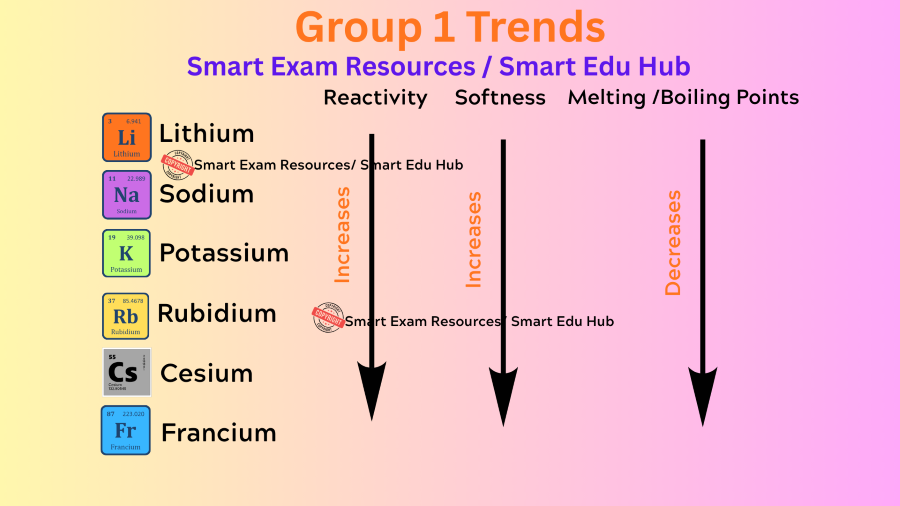
Trend: metals become softer down the group.
Lithium -> harder ;   Sodium -> softer  ;   Potassium -> even softer

(b) Low melting points

Element Approx. melting point
Lithium 180°C
Sodium 98°C
Potassium 63°C
Trend: melting point decreases down the group.
Li > Na > K
As atomic size increases, attraction between metal ions and electrons becomes weaker, so less energy is needed to melt the metal.

(c) Density

Element Density
Lithium 0.53 g/cm3
Sodium 0.97 g/cm3
Potassium 0.86 g/cm3
  • They are low-density metals
  • Lithium, sodium and potassium float on water
Trend: density generally increases down the group.
3. Chemical Property

Reactivity of Group I metals

Why they are reactive

Group I metals are very reactive metals.
  • They react easily with water
  • They react easily with oxygen
  • They react easily with halogens
Because they are very reactive, they are stored in oil to prevent reaction with air or water.

Reaction with water

General reaction:
Metal + Water ? Metal hydroxide + Hydrogen
2Na + 2H2O -> 2NaOH + H2
Trend: reactivity increases down the group.

Observations when added to cold water

Metal Observation
Lithium Fizzes slowly
Sodium Melts into a ball and moves quickly
Potassium Reacts violently and burns with a lilac flame
4. Trends

Summary of trends down Group I

Property Trend down Group I
Atomic size Increases
Density Generally increases
Melting point Decreases
Softness Increases
Reactivity Increases
5. Prediction

Predicting the properties of other Group I elements

Using the trend

We can use Group I trends to predict the properties of other alkali metals such as rubidium (Rb) and caesium (Cs).
  • More reactive than potassium
  • Lower melting point than potassium
  • Very soft metals

Example prediction

Caesium reacts very violently with water and is even more reactive than potassium.
This matches the trend that reactivity increases down Group I.
Exam Summary

Key exam points to remember

Group I metals have one outer electron
They form +1 ions
They are soft metals
Melting point decreases down the group
Density generally increases down the group
Reactivity increases down the group
This layout matches the same style as your earlier notes and keeps everything mobile-friendly and script-free.

Syllabus Objectives

CORE:

  • Describe the Group I alkali metals, lithium, sodium and potassium, as relatively soft metals with general trends down the group, limited to:
  • (a) decreasing melting point
  • (b) increasing density
  • (c) increasing reactivity
  •  Predict the properties of other elements in Group I, given information about the elements

Revision Notes

IGCSE Chemistry Notes Group I properties

The above video is a preview of the actual revision notes available as a part of the paid membership. All learning resources in the form of pdfs that are available on the website are 100% printable and downloadable


Topic: Group I Elements / Test Your Understanding

Study the table carefully, then click the highlighted answer spaces to reveal the correct answers.

1 Information Table

The table below gives some information about the elements in Group I of the Periodic Table.

element boiling point / °C density / g cm?3 radius of atom in the metal / nm reactivity with water
lithium 1342 0.53 0.157  
sodium 883 0.97 0.191 rapid
potassium 760 0.86 0.235 very rapid
rubidium   1.53 0.250 extremely rapid
caesium 669 1.88   explosive

2 Answer the Questions

(a) How does the density of the Group I elements change down the Group?
Click to reveal answer Increases overall down the group, although the trend is not perfectly regular.
(b) Suggest a value for the boiling point of rubidium.
Click to reveal answer Approximately 686°C. Acceptable range: 670–714°C.
(c) Suggest a value for the radius of a caesium atom.
Click to reveal answer Approximately 0.272 nm. Acceptable range: 0.260–0.300 nm.
(d) Use the information in the table to suggest how fast lithium reacts with water compared with the other Group I metals.
Click to reveal answer Lithium reacts more slowly than sodium and the other Group I metals. Accept: slow, slower, less rapid, or gently.
(e) State three properties shown by all metals.
Click to reveal answer Any three from: conduct electricity, conduct heat, malleable, ductile, shiny, sonorous, solid at room temperature.

Members Area

Unlock the complete range of solved past exam papers along with mock exams, revision notes, timed quizzes, interactive flipbooks and many more exam preparation resources.

Unlock Complete Resources
Next Previous