We use cookies to ensure that we give you the best experience on our website. We adhere to the GDPR and EU laws and we will not share your personal information with or sell it to third-party marketers. If you continue to use this site we will assume that you are happy with it. Our privacy policy
Giant covalent structures of Diamond/Graphite/Silicon(IV) oxide
Overview
Macromolecules are giant covalent structures
They have a rigid three dimensional network of strong covalent bonds throughout the crystal.
It takes a lot of energy to break the bond
They have very high boiling and melting points.
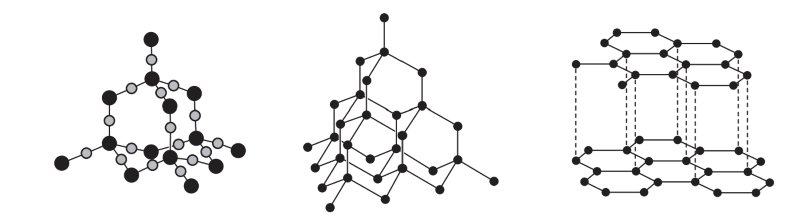
Example of giant covalent structures are: Graphite, diamond and [Silicon(IV) oxide-also called as silicon dioxide]
Diamond and Silicon
Diamond
Silicon Dioxide
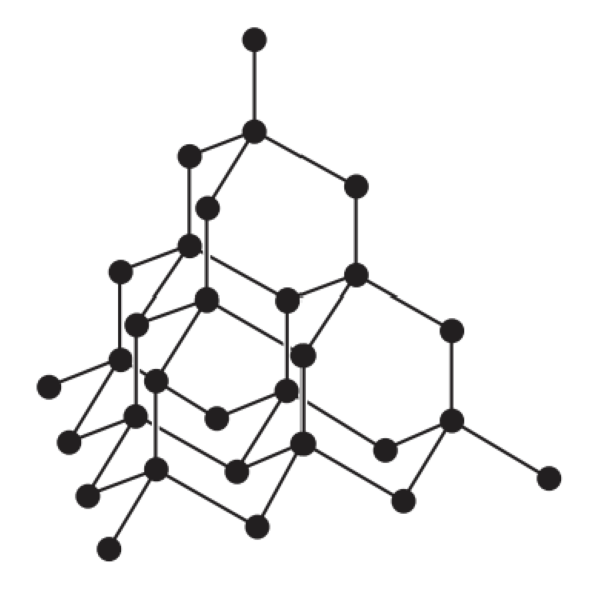
Diamond
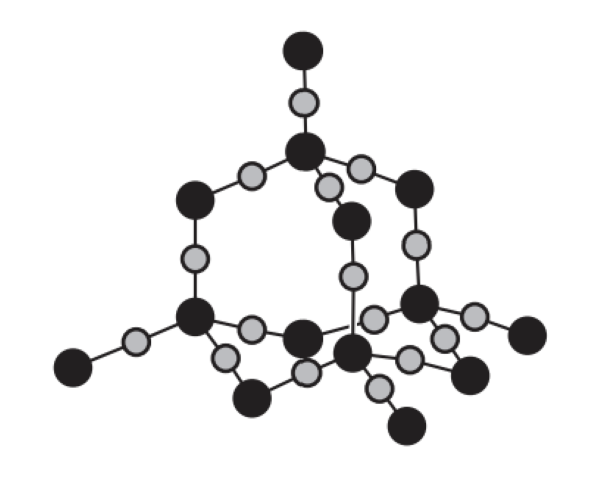
Silicon Dioxide
Structure
Bonding
One carbon atom is bonded to 4 other carbon atoms and no electrons are set free.
One silicon atom is bonded to 3 other oxygen atoms and no electron is set free.
Electrical Conductivity
Does not conduct electricity as it does not have any delocalised electrons
Does not conduct electricity as it does not have any delocalised electrons
Melting and boiling point
High-because a lot of energy is needed to break the strong covalent bonds.
High-because a lot of energy is needed to break the strong covalent bonds.
Hard
Very hard-It can't be scratched easily
Very hard-It can't be scratched easily
Colour
Colourless
Colourless
Graphite
Graphite is a black shiny solid.
It's carbon atoms are arranged in layers.
Every layer consists of carbon atoms in hexagonal ring.
Each carbon atom is covalently bonded to 3 other carbon atoms and one electron is set free. Thus in the entire lattice there is a sea of delocalised electrons. Hence graphite conducts electricity because the delocalised electrons can drift along the layers when voltage is applied. As graphite conducts electricity , it is used to make electrodes for electrolysis.
Graphite has a slippery feel as the bonding between the layers in graphite is weak. hence the layers can slide past each other. Hence it has a slippery feel.
The layers of graphite can flake off because of this weak bonding. hence it is used as a lubricant and in pencil lead
Syllabus Objectives
CORE:
Describe the giant covalent structures of graphite and diamond
Relate the structures and bonding of graphite and diamond to their uses, limited to:
(a) graphite as a lubricant and as an electrode
(b) diamond in cutting tools
EXTENDED:
Describe the giant covalent structure of silicon(IV) oxide, SiO2
Describe the similarity in properties between diamond and silicon(IV) oxide, related to their structures
The above video is a preview of the actual revision notes available as a part of the paid membership. All learning resources in the form of pdfs that are available on the website are 100% printable and downloadable.
Topic: Giant Covalent Structures / Test your Understanding
Click the highlighted blanks to reveal the correct answer.
1What are Giant Covalent Structures?
1. A giant covalent structure is a large
________________network
of atoms joined by
________________covalent bonds
.
2. Giant covalent structures have very
________________high
melting and boiling points.
3. A large amount of
________________energy
is required to break the covalent bonds.
4. Examples include
________________diamond
,
________________graphite
, and
________________silicon(IV) oxide
.
2Diamond
5. Diamond is made entirely of
________________carbon
atoms.
6. Each carbon atom forms
________________four
covalent bonds.
7. Diamond has a giant
________________three-dimensional
structure.
8. Diamond does not conduct electricity because it has no
________________free electrons
.
9. Diamond is extremely
________________hard
.
10. Diamond is used in
________________cutting tools
.
3Graphite
11. In graphite, each carbon atom forms
________________three
covalent bonds.
12. Graphite atoms are arranged in
________________layers
.
13. One electron from each carbon atom is
________________delocalised
.
14. Graphite can conduct
________________electricity
.
15. The layers are held together by
________________weak forces
.
16. Graphite is used as a
________________lubricant
.
17. Graphite is used as an
________________electrode
in electrolysis.
4Silicon(IV) Oxide (SiO2)
18. Silicon(IV) oxide is also called
________________silica
.
19. Its chemical formula is
________________SiO?
.
20. Each silicon atom bonds to
________________four
oxygen atoms.
21. Silicon dioxide forms a giant
________________three-dimensional
network.
22. Silicon dioxide does not conduct electricity because it has no
________________free electrons
.
5Similarities Between Diamond and Silicon(IV) Oxide
23. Both have
________________giant covalent
structures.
24. Both have very
________________high melting points
.
25. Both do not conduct
________________electricity
.
6Summary Review
26. Graphite conducts electricity because it contains
________________delocalised electrons
.
27. Diamond does not conduct electricity because it has no
________________free electrons
.
28. Graphite layers slide because they are held by
________________weak forces
.
29. Diamond is used in cutting tools because it is extremely
________________hard
.
30. Silicon(IV) oxide forms a giant covalent
________________lattice
.
Members Area
Unlock the complete range of solved past exam papers along with mock exams, revision notes, timed quizzes, interactive flipbooks and many more exam preparation resources.



Write a public review