IGCSE Chemistry Revision Notes Isotopes

Download PDF

IGCSE Chemistry Notes / Isotopes

Definition and examples

Isotopes are different atoms of the same element that have the same number of protons but different numbers of neutrons.

Examples of some isotopes

Elements Isotopes
Chlorine 3517Cl   3717Cl
Carbon 126C   136C
Hydrogen 11H   21H   31H

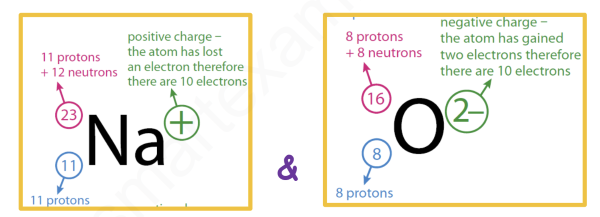
Interpretation of some special symbols

Example: 1

3517Cl?

  • The above symbol has a 1- charge . This indicates that the above is an ion of Chlorine ( the chloride ion) and is formed by accepting an electron. Hence it now has 17+1=18 electrons.
  • Z=17 =atomic number=number of protons
  • A= mass number=total number of protons and neutrons=35

Example: 2

2412Mg2+

  • The above symbol has a 2+ charge . This indicates that the above is an ion of Magnesium and is formed by losing 2 electrons. Hence it now has 12-2=10 electrons.
  • Z=12 =atomic number=number of protons
  • A= mass number=total number of protons and neutrons=24.

isotopes-igcse-chemistry-notes

Calculate the relative atomic mass

 relative-atomic-mass-calculation-igcse-chemistry

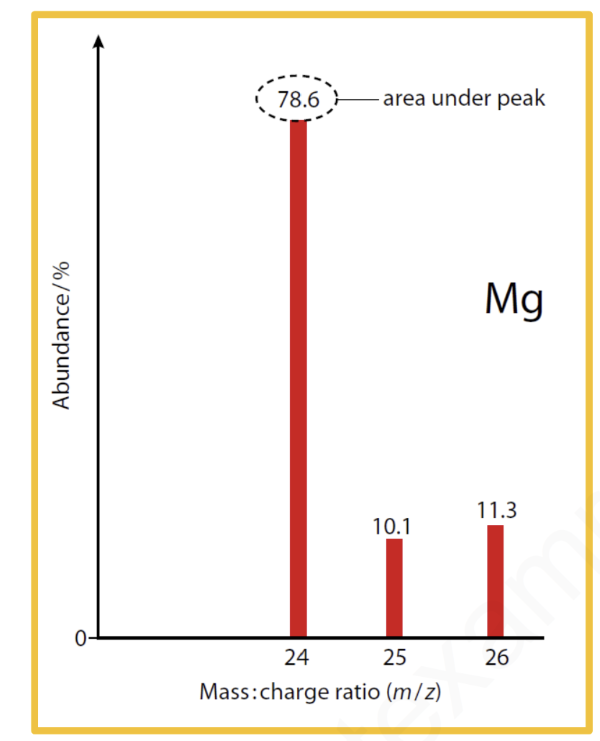
  • In the adjoining diagram, is shown , a mass spectrum of Magnesium.
  • Using a mass spectrometer, the proportion of each isotope present in a sample of an element can be measured.
  • The readout of the mass-spectrometer is called as the mass spectrum.
  • In the mass spectrum every isotope appears to have one peak. The height of each peak (also called as the area under each peak) is proportional to the number of atoms of the isotope in the sample tested.
  • The relative atomic mass can be calculated in the following way:
Ar = ((78.6 × 24) + ((10.1 × 25) + (11.3 × 26))) / 100 = 24.3

Note: The scale on the x-axis is m/z, which represents the mass:charge . we can also consider this to be the mass of the isotope. [ Detailed explanation has not been provided as it is not required as per the syllabus].

Syllabus Objectives

CORE:

  • Define isotopes as different atoms of the same element that have the same number of protons but different numbers of neutrons
  •  Interpret and use symbols for atoms, e.g. 12C6, and ions, e.g. 35 17Cl

EXTENDED:

  • State that isotopes of the same element have the same chemical properties because they have the same number of electrons and therefore the same electronic configuration
  • Calculate the relative atomic mass of an element from the relative masses and abundances of its isotopes

Video Lectures

The above video is a preview of the actual revision notes available as a part of the paid membership. All learning resources in the form of pdfs that are available on the website are 100% printable and downloadable.

IGCSE Chemistry Revision  Interactive Notes Isotopes

Topic: Atoms, elements and compounds
 

igcse-chemistry-notes-isotopes

Topic: Isotopes

Click the highlighted blanks to reveal the correct answers.

1 Definition of Isotopes

1. Isotopes are atoms of the
________________ same element
that have the same number of
________________ protons
but different numbers of
________________ neutrons
.
2. Isotopes have the same
________________ atomic number
but different
________________ mass numbers
.

2 Examples of Isotopes

3. Carbon-12 contains
________________ 6
protons and
________________ 6
neutrons.
4. Carbon-14 contains
________________ 6
protons and
________________ 8
neutrons.

3 Isotope Notation

5. The top number in isotope notation represents the
________________ mass number
.
6. The bottom number in isotope notation represents the
________________ proton number
.
7. The element symbol (e.g., C or Cl) identifies the type of
________________ atom
.

4 Chemical and Physical Properties

8. Isotopes have the same chemical properties because they have the same number of
________________ electrons
.
9. Chemical properties depend mainly on the number of electrons in the
________________ outer shell
.
10. The only difference between isotopes is their number of
________________ neutrons
.
11. Isotopes can have different
________________ physical properties
such as density or rate of diffusion.

5 Relative Atomic Mass

12. The relative atomic mass of chlorine calculated from its isotopes is approximately
________________ 35.5
.
13. The relative atomic mass of boron calculated from its isotopes is approximately
________________ 10.8
.

Members Area

Unlock the complete range of solved past exam papers along with mock exams, revision notes, timed quizzes, interactive flipbooks and many more exam preparation resources.

Unlock Complete Resources
Next Previous