We use cookies to ensure that we give you the best experience on our website. We adhere to the GDPR and EU laws and we will not share your personal information with or sell it to third-party marketers. If you continue to use this site we will assume that you are happy with it. Our privacy policy
Notes arranged by syllabus objectives, with extra content placed under Keypoints.
Describe and explain diffusion in terms of kinetic particle theory
Define diffusion
Diffusion is the random movement of particles from a region of their high concentration to a region of their low concentration down the concentration gradient.
Why do the gases diffuse?- Explanation based on kinetic theory
Gases diffuse because their particles move in random motion.
These particles then collide.
This diffusion is from a region of high concentration to a region of low concentration.
Describe and explain the effect of relative molecular mass on the rate of diffusion of gases
This means that the speed of diffusion of a gas depends on how heavy it's molecules are.
Molecules with a lighter mass diffuse faster than those with a heavier mass.
At the same temperature, the molecules that have the lower mass diffuse faster than the heavier molecules.
If the lighter and heavier molecules have the same amount of energy when they collide, then, the lighter ones will bounce off the heavier ones at a faster rate.
So, lighter molecules diffuse faster than the heavier molecules.
Keypoints
Diffusion happens faster in warmer temperatures than in cooler temperatures.
When a liquid spills on a floor and can be smelt far away it means that it has first evaporated then diffused.
When a precipitate is formed during chemical reactions, the particles, diffuse, collide and then react
Particles spread out evenly as a result of diffusion
Note here sugar dissolves then diffuses. You cannot say sugar melts and then diffuses.
Generally diffusion happens in liquids and gases as the particles are free to move. Their particles are constantly moving colliding and changing directions.
Diffusion in gases is faster than diffusion in liquids because the gas particles move rapidly. They are able to move freely because kinetic theory assumes that there are no forces of attraction between the gas particles while there are weak forces of attraction between liquid particles.
Diffusion does not happen in solids because the particles are tightly packed and they can only vibrate in their mean positions and not move about.
Diffusion can occur in liquids which are miscible
Diffusion is also possible in solids that dissolve in liquids.
Video Lectures
Topic: States of matter
Sub Topic: 1.1 Solids, liquids and gases / Diffusion
IGCSE Chemistry Revision Notes Diffusion
Free download IGCSE Chemistry Diffusion Notes 2024 to 2028 Exams
IGCSE Chemistry Solved Past Paper Question Diffusion
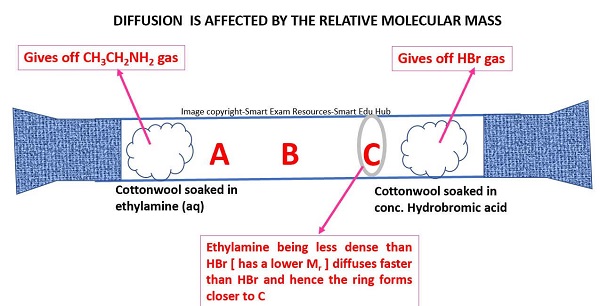
Observations
The white ring is formed at C because ethylamine is less dense (lower Mr) than HBr.
Hence ethylamine diffuses faster than HBr.
Why do the gases diffuse? (Kinetic theory explanation)
Gases diffuse because their particles move randomly and collide with each other. This movement causes particles to spread from a region of high concentration to a region of low concentration.
Diffusion happens faster in warmer temperatures than in cooler temperatures.
IGCSE Chemistry Diffusion / Test Yourself
Summary Fill in the Blanks
Click the highlighted blanks to reveal key ideas about diffusion. Headings are retained and the blanks are designed for IGCSE Chemistry level.
1Definition of Diffusion
Diffusion is the
________________random
movement of particles from an area of high concentration to an area of low concentration.
This movement takes place down the concentration
________________gradient
.
2Factors Affecting the Speed of Diffusion
Lighter molecules diffuse
________________faster
than heavier molecules.
Relative molecular
________________mass
affects the speed of diffusion.
Diffusion happens more quickly at
________________warmer
temperatures than at cooler temperatures.
3Diffusion in Gases
Gas particles move in
________________random
motion and collide with each other.
Diffusion in gases is
________________fast
because particles move rapidly and freely.
Ethylamine diffuses faster than HBr because it has a lower relative molecular
________________mass
.
Kinetic Theory Explanation
In gases, forces of attraction are
________________negligible
, so particles spread out quickly.
4Diffusion in Liquids
Particles in liquids are free to
________________move
and collide, so diffusion can occur.
Diffusion in liquids is
________________slower
than in gases.
This is because there are weak forces of
________________attraction
between particles.
When a liquid can be smelt far away, it has first
________________evaporated
and then diffused through the air.
5Diffusion in Different States of Matter
Diffusion is fastest in
________________gases
.
Diffusion is slower in
________________liquids
.
Diffusion does not occur in
________________solids
because particles are tightly packed and only vibrate in fixed positions.
6Miscellaneous Points
Diffusion can occur in
________________miscible
liquids.
Diffusion is also possible for solids that
________________dissolve
in liquids.
At the same temperature, lighter molecules diffuse faster than
________________heavier
molecules.
You need to know:
(a) Diffusion is the random movement of particles from a region of high concentration to a region of low concentration.
(b) Diffusion occurs down a concentration gradient.
(c) Diffusion is fastest in gases and slower in liquids.
(d) Lighter particles diffuse faster than heavier particles at the same temperature.
(e) Diffusion in solids does not occur because particles only vibrate about fixed positions.
Members Area
Unlock the complete range of solved past exam papers along with mock exams, revision notes, timed quizzes, interactive flipbooks and many more exam preparation resources.


.png)